THE LONG WAY NORTH: A NORDIC LEADERSHIP STORY
From engineer to president of PWN Norway, Valentina Buratti reflects on leadership, resilience, and the power of radical responsibility. Her journey shows how ambition, community, and service can create lasting impact far beyond a job title.
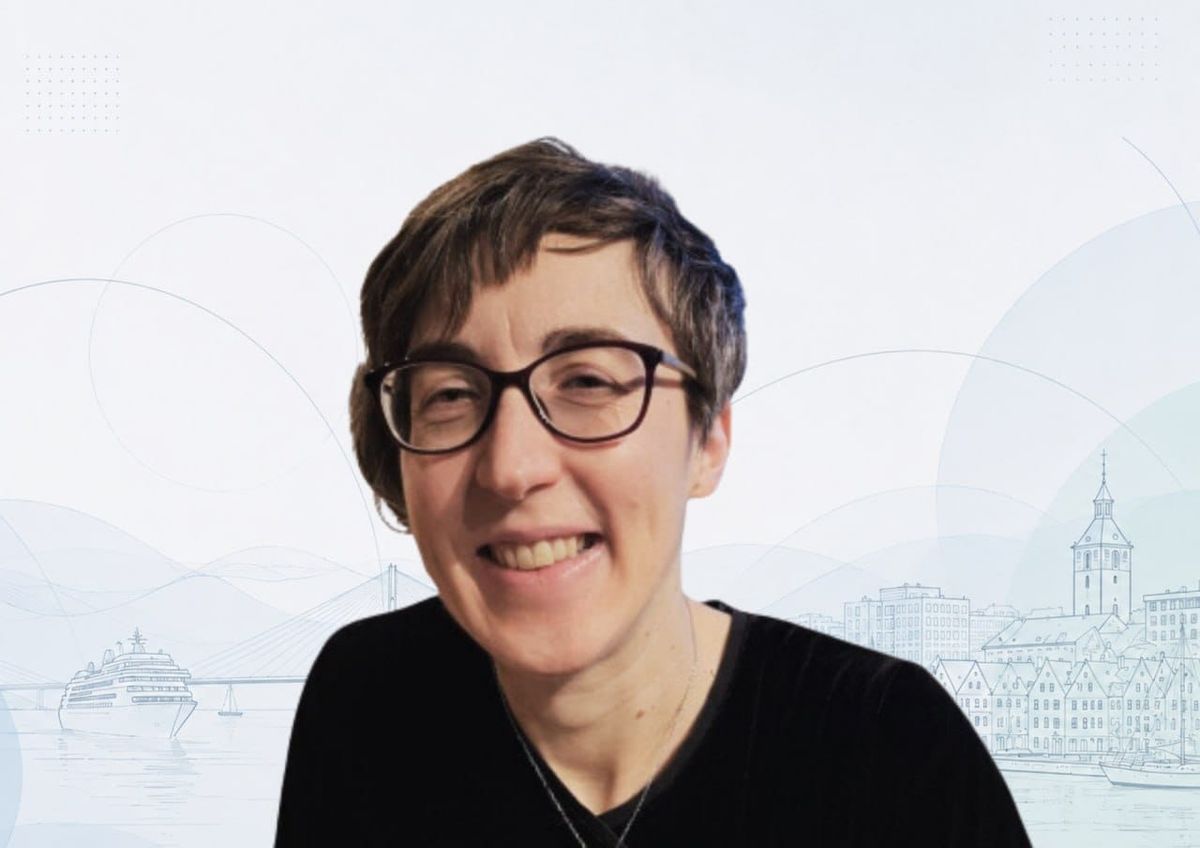
An engineer raised beside the Temple of Speed. A life rerouted by a single Erasmus semester. A leader who spent two years proving that the strongest thing a person in charge can say is: this one's on me.
Valentina Buratti grew up in Monza, a city in Italy known for one thing: speed. Monza is the home of the Autodromo, the "Temple of Speed," a place of roaring engines, high-speed cars, and a particular kind of male mythology. For a teenage girl there, the lesson was that engineering — the discipline behind all that velocity — belonged to someone else. She drew the opposite conclusion. She would become an engineer, and in doing so quietly correct the assumption that the temple had only one kind of worshipper.
What followed was less a straight line than a series of well-judged turns. She studied aeronautical engineering at the Politecnico di Milano, and during her master's an Erasmus scholarship sent her north to Trondheim. For many students, the Erasmus semester is a pleasant interruption. For Buratti it turned out to be a hinge. After graduating she returned not to Italy but to the south-west coast of Norway, where she began working in the energy sector as an engineer for subsea operations.
It is worth pausing over that decision, because it is the part of her story that will be most familiar to CASI Voice readers. To build a career in a country not your own — in a second language, inside an industry with its own dense culture — is to accept a permanent, low-level translation tax on everything you do. Buratti paid it for more than a decade and turned it into an asset. Sailing, as she puts it, through Denmark and Singapore, she moved from subsea structures to wind, joining one of the world's largest turbine manufacturers. She returned to the Norwegian continental shelf with one of the major offshore EPCI companies. Today she is a principal structural engineer working on projects in the Ivar Aasen field. The CV reads like a map of the North Sea energy world, drawn by someone who keeps choosing the more challenging, more interesting room to be in.
The volunteer who became president
Buratti made room for something without a salary attached. She began volunteering with the Professional Women's Network, the global non-profit that works to advance gender-balanced leadership, and in January 2024 she became president of the city network in Norway — covering both Stavanger and Oslo. For two years she led it; at the end of 2025 she handed the presidency to her successor, Dr. Claudia A. McDonald Bøen, and moved into a global role with PWN's online membership team.
Ask her how the organisation looks at the close of her term and she does not reach for conquest language. She describes an organisation that has grown more mature, more confident, more sure of why it exists. It is better governed, more visible, working with partners who believe in the mission. But the strength she returns to is not structural. It is human. The volunteer base, she says, is the heart of the thing; the "one-team" culture will carry it forward. It is a revealing emphasis. A certain kind of leader focuses on winning. Buratti counts people.
What the hard years taught her
The most instructive part of any leadership story is rarely triumph. It is the moment the floor gives way. For Buratti that moment came when a local team struggled and several volunteers left, bringing the operation close to a standstill. In an organisation that runs on goodwill, losing volunteers is not an inconvenience; it is an existential threat, and she felt it personally.
What she did next is the through-line of her entire leadership philosophy. She did not seek external explanations. She looked inward first and asked where her own leadership had not been clear or present enough. Then she began to work on rebuilding alignment around the shared purpose, and delivering what was promised.
She has a name for this instinct: radical responsibility — the choice to fully own whatever is happening, to set down blame, and to meet each situation with curiosity rather than defensiveness. It is a deceptively demanding idea. Most of us, under pressure, are fluent in the grammar of "if only they had." Buratti trained herself to start the sentence with "I." She is candid that the crisis shaped her more than any success did, and that real leadership, in her telling, begins with ownership and the willingness to grow alongside the things you serve.
For a magazine whose readers lead teams, boards, and companies, this is the most portable thing she offers. Radical responsibility is not self-blame; it is the refusal to be a passenger in your own situation.
A vision that ends with the door closing
The most unexpected thing Buratti says about the organisation she has devoted years to is that she wants it, ultimately, to become unnecessary. If PWN truly succeeds, she argues, the very idea of "women's empowerment" should one day feel dated — proof that balance has become the norm rather than the exception. The organisation would then evolve, transform, and redefine its purpose. This was not because the work failed but because it changed the system it set out to change.
It is strikingly secure for a leader to say that the goal is to build something that can be set down. Around that long horizon she places three near priorities for PWN internationally — closer collaboration between the global and local networks, a fuller picture of a woman's career that runs from the first graduate job to the C-suite rather than fixing on any single stage, and a genuine effort to bring men into the work as partners rather than spectators. None of it is delivered as a grievance. It reads as organisational design — the calm strategy of someone who has spent her working life making complicated structures hold together under load.
Be ambitious
She closes the way she opened her own 2025, with a line she means as a gift rather than a slogan: "Girls, be ambitious." She stretches the word past its usual borders. Be ambitious enough to imagine a future that doesn't exist yet, she says, and brave enough to move toward it before the path is clear. And let ambition be about more than titles — about knowledge, integrity, impact, and lifting other people as you climb.
There is a quiet note underneath it. PWN, she says, is no longer a role she has stepped out of but something she carries. It is built from the people, the conversations, the friendships, and a sense of belonging she calls rare. The more you give to a community like that, she has found, the more it gives back, often in ways you never expected.
It is a fitting close to a profile in a magazine built on culture, achievement, science, and identity, because Buratti's story touches on all four. The engineer from the Temple of Speed did not, in the end, prove a point about who belongs in the room. She did something more useful. She built rooms, filled them, and taught the people inside to take responsibility for what happened next.
Valentina Buratti is a principal structural engineer in Norway's offshore energy sector and served as president of PWN Norway from 2024 to 2025. This profile draws on her farewell interview for PWN Norway.