I recently listened to Proto: How One Ancient Language Went Global (2025, Bloomsbury Publishing), an essential examination by Laura Spinney on the Proto-Indo-European language. In it, she quotes the Roman poet Quintus Ennius (239–169 BC) who famously said, “I have three hearts,” because he knew how to speak Greek, Oscan, and Latin. It is a beautiful image, illustrating the idea that expanding your languages deepens your capacity to inhabit multiple cultural identities.
But long before I ever dreamed of having multiple linguistic hearts, my relationship with words started with just one language. My love for books began around age 4. My French village was tiny, 250 inhabitants, no kindergarten, nothing for young kids. So my mother figured out that if she taught me how to read, I would no longer be bored and would leave her alone. It worked, and that was the beginning of an incurable obsession. There was no library in the village, so I would read anything printed I could find, like the daily newspaper.
Shortly after, I became fascinated by foreign languages. I remember, when I was about 5 or 6, talking at home with a relative visiting from Sweden where he was working as a diplomat, asking him and writing down how to say basic conversation words in Swedish.
I was actually experiencing at the time a painful family situation, so I believe my passion for reading grew even deeper, as both French and foreign words became my escape into a better world.
Finally, English turned into my definitive safe haven when I was 10. At the end of my first class of English, I totally fell in love with it. Our teacher Monique asked us to write down which career we would like to choose later on in life. I wrote: “I will be an English teacher.” And I did, nine years later.
With Monique’s help, I improved quickly in English, started even dreaming in it, spent a few summers in England, got my master’s degree in ‘English and American Language and Civilization’, and started teaching English.
I did it for two years before my life changed dramatically, propelling me to the next chapter, where I was going to immerse myself far more deeply in the English language.
Indeed, twenty-five years ago, I ended up uprooting myself from French soil to replant myself in the US.
But a newly transplanted life takes time to adapt to a completely new culture. The tension was initially uncomfortable, leading me to distance myself from my origins. For a few years, I actually stopped reading any French literature, totally disregarding my own culture and being even very critical of it.
However, my story couldn’t stop there in a dead-end. Because of my previous professional experience as an English teacher in France, I was soon asked to do some simultaneous translation work, challenging me to reconcile my two hearts, to use Ennius’s image. Translating several mystery novels into French tremendously helped me rediscover the richness of French language and literature. My book blogging community (I have been book blogging at Words And Peace for sixteen years, and organizing virtual book tours at France Book Tours), so appreciative of the French world, and my ever-curious French students (I am now an online French tutor) have also been powerful catalysts in bridging my two linguistic worlds.
Ten years ago, I read In Other Words (2016, Knopf). In it, Jhumpa Lahiri offers powerful reflections on what it is to live in balance between two languages, and how it has been changing her mind and her life.
From a Bengali background, Lahiri was brought up in America and quickly mastered English. But her own odyssey went further: after a trip to Italy, she madly fell in love with the Italian language, ended up living in Rome for a while, and writing books in Italian.
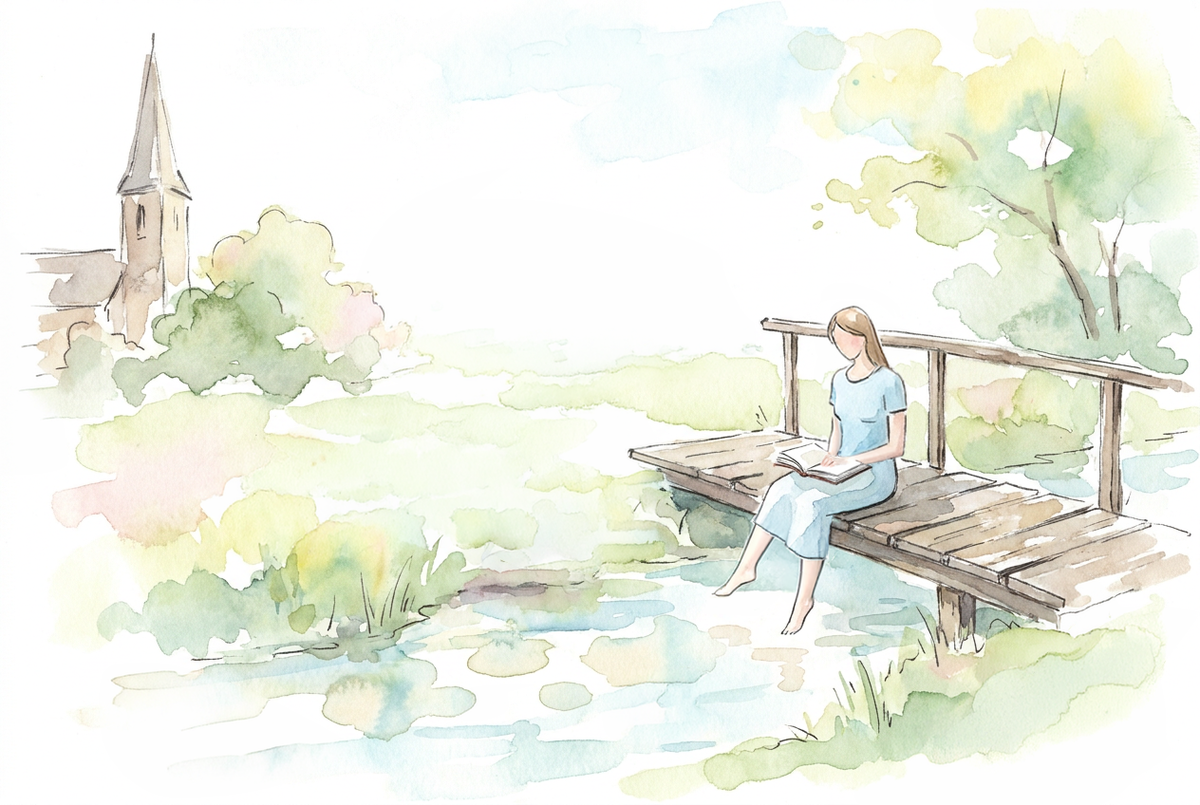
Lahiri uses great metaphors for comparisons between language and geography. Her image of the bridge especially speaks volumes to me. On a daily basis, I feel myself trying to build bridges between two languages, two cultures, at the risk of being sometimes stuck in the middle and belonging to neither world.
A simple fact will illustrate it: no one in Illinois would accuse me of having a Chicago accent. But when I speak to my French relatives over the phone, they tell me I have an American accent. Obviously, they don’t really know what an authentic American accent sounds like, but there’s something that tells them my accent is no longer the “pure” (if there’s such a thing) French one either!
During a trip back to France after many years abroad, I was even congratulated on my good French at a tourism office on my first day there!

While these moments can be laughed off, the sense of estrangement runs much deeper. Like Lahiri, I often experience the sensation of being two different persons with contrasting attitudes, depending on the language I use. Feeling caught in the middle with a mixed linguistic identity has sometimes been dizzying.
Nonetheless, over the years, I have become extremely grateful for having received the gift and opportunity of expressing myself and reading in two languages. It is a way of being that nourishes my life and my literary connections. Every month, I read and listen to a balanced amount of French and English books. My personal odyssey has led me to embrace this deep enrichment of having multiple hearts through bilingualism.
When you acquire a second language so deeply that you begin to dream, read, teach, and write in it, your relationship with literature changes. You become a bifocal reader. The duality that I first experienced as a fragmentation has now become a broadening of perspectives. Reading across languages has allowed me to see that a single idea can wear entirely different textures. Through showing me the beauty of nuances, it has been teaching me openness.
Living and reading with two languages means accepting that there will always be a gap. As I grow older, this gap is no longer a deficit. It has become my space where creativity and empathy can thrive. It has forced me to look closer, to listen harder, and never to take communication for granted.
Home is no longer for me a fixed coordinate on a map. Home now happens for me through a cross-cultural dialogue inside my mind, as well as through the books I read, and within a global community of readers. I now find belonging in the fluid movement between my French and my English worlds.
In Genesis 11, the variety of languages is presented as an impediment to building cities and high towers. But we also have the choice and the possibility to turn it into bridges that will lead us to discover the richness of the other, and ultimately experience deeper unity with the whole world.
I strongly believe that multilingualism can be an important factor of mutual respect and intercultural dialogue. As readers navigating our cross-cultural journeys, we are invited to embrace the other. Let our reading lists be as beautifully complex and geographically fluid as our lives. We do not have to choose one language or one culture over another. We can stand firmly on the bridge between them, with a book in our hand, completely at home.