Identity-Europe
Liz Adams: Moving Herself, Not Her World
An American figurative painter in Paris on reclaiming pink, painting goddesses, and discovering that a new country asks you to change more than your address.
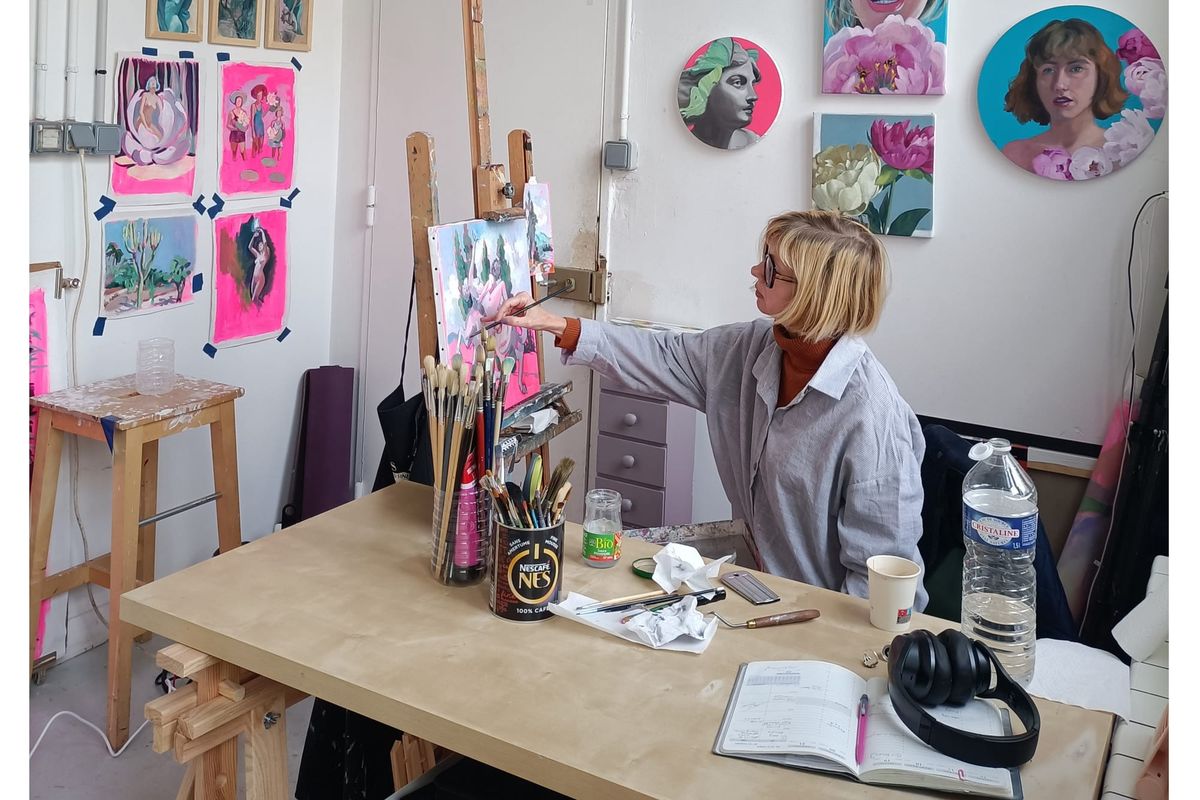
At eighteen, Liz Adams had already decided she had no talent. An artistic child, she grew so self-critical as a teenager that she gave up drawing altogether. Then a friend persuaded her to join an oil painting class. Her first subject was a bunch of white roses.
“It just clicked,” she says. “I fell in love and said, I want to do this for the rest of my life.” Thirty years later, she is still doing it, and the love affair has carried her from Georgia to New York, through Vietnam, and finally to Paris.
A classical training, a New York career
After a degree in drawing and painting at Georgia State University, Adams moved to New York to study at the Art Students League and the National Academy School of Fine Art, with a summer studying Renaissance art in Florence. Her student years turned into fifteen years in the city. She exhibited widely, taught at the Art Students League, and in 2015 received the Elizabeth Greenshields Foundation Grant, which recognises a commitment to figurative art.
Teaching has always run alongside the painting. “Being a painter and being a teacher really speak to each other,” she says. Today she runs online classes, monthly workshops and one-to-one mentorships, guiding students step by step until they hold a finished portrait or landscape series of their own.
A visa, and then a pandemic
In 2016, a period of personal change took Adams to Hanoi for an artist residency. She stayed on to travel and teach in Southeast Asia, and returned with a realisation: she had always wanted to live abroad. A French friend she had known since her teens invited her to spend a few months with her family outside Paris, and the city took hold. “There’s just a plethora of culture and art in Paris,” she says, “and old world art, which does draw me.”
She spent 2019 assembling her visa application. Her passport, visa inside, arrived from the French embassy in mid-March 2020. “The next day, I knew I wasn’t going anywhere.” It took until autumn, when France briefly opened its borders between lockdowns, for her to fly from Atlanta to Paris. She remembers perhaps four passengers on the plane.
Sweets as a bridge
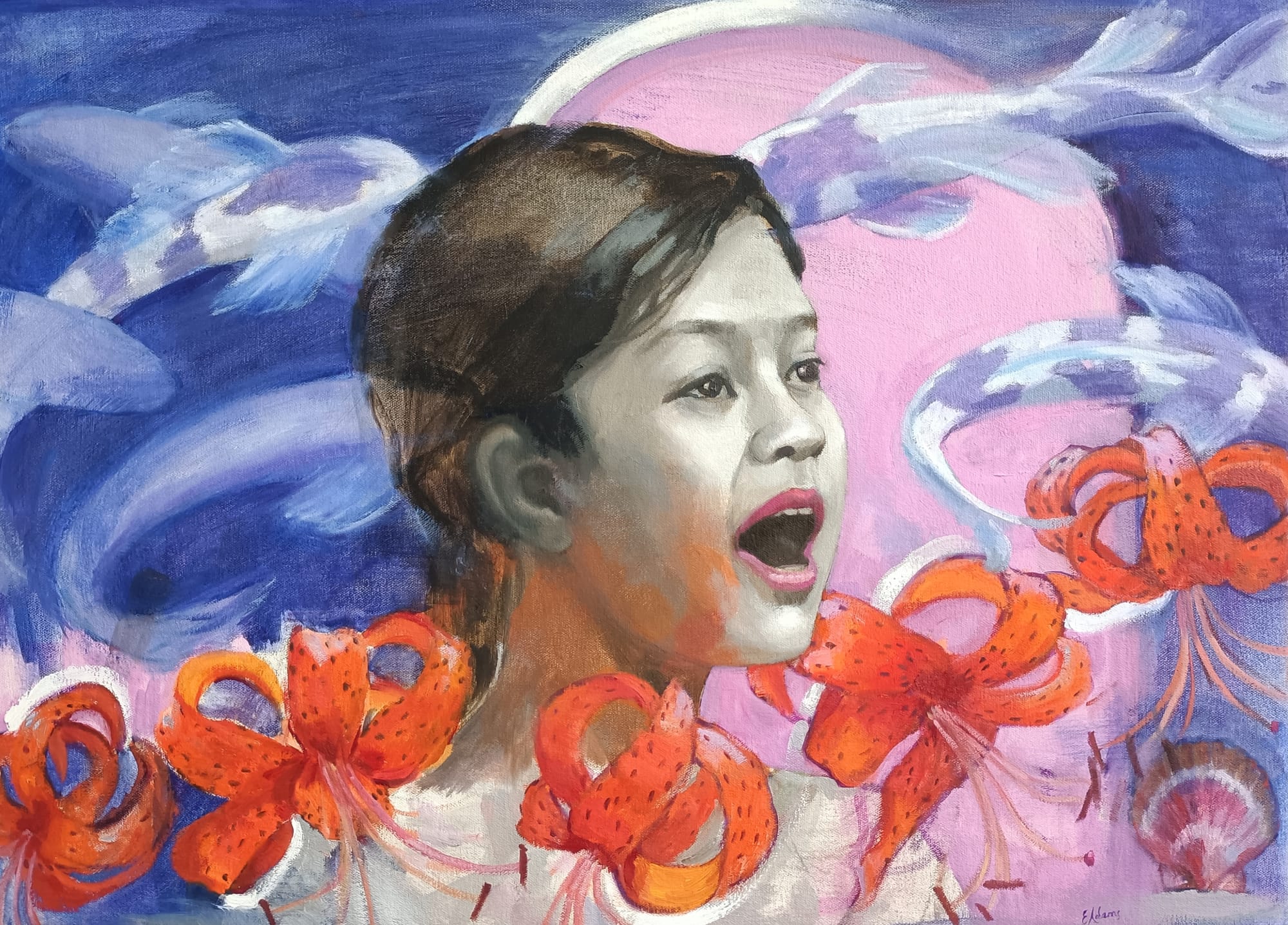
Waiting out lockdown in Georgia, living with her sister after fifteen years in New York, Adams painted her way through nostalgia: Skittles, Oreo cookies, the treats of an American childhood. People online responded at once. In France she kept going, adding traditional pastries and, inevitably, macarons. The series grew larger and more pop in feeling, and for years it was her bestselling work.
“It was kind of that bridge from the world I came from to the new world I moved to,” she says. It also opened French doors. In 2025 the Alliance Française in Nice hosted Rêves Sucrés, an exhibition of the series, with macarons for the guests and a presentation Adams gave in French. She now considers the series complete. The method had its perks: buy the macarons, photograph them, eat a few, paint the rest.
Reclaiming pink
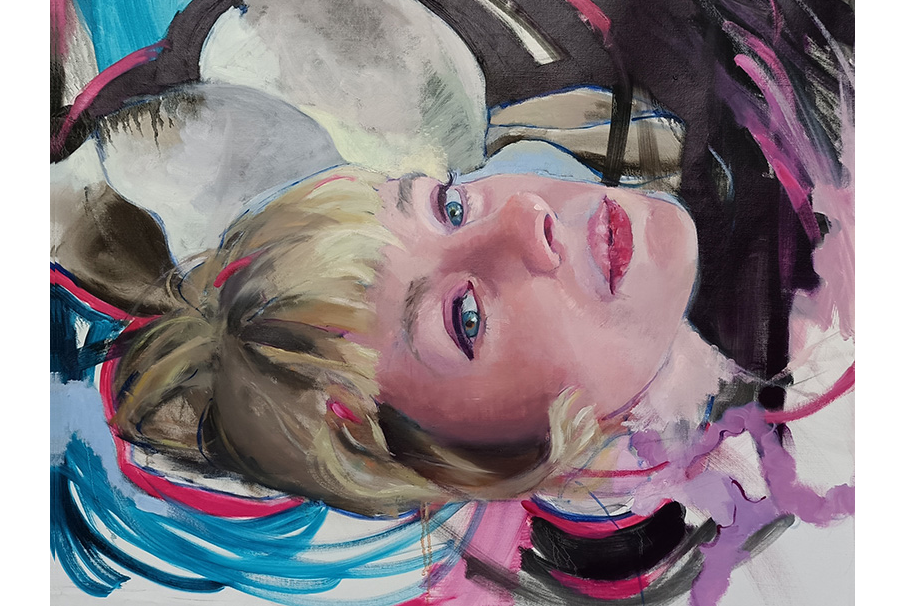
Look at almost any Adams painting and you will find pink. It arrived about ten years ago, at the end of one era of her life, when someone gave her a tube of quinacridone rose. She was working largely in black and white at the time, and pink became the only colour she let in.
“It became such a representation of the feminine, but for me not in a girly, weak way,” she explains. “In a powerful, embodied way.” She now layers fluorescent acrylic beneath her oils so it glows through, “almost like a breath underneath the surface.” Her verdict is simple: “I can’t paint without my magenta.”
Goddesses and archetypes
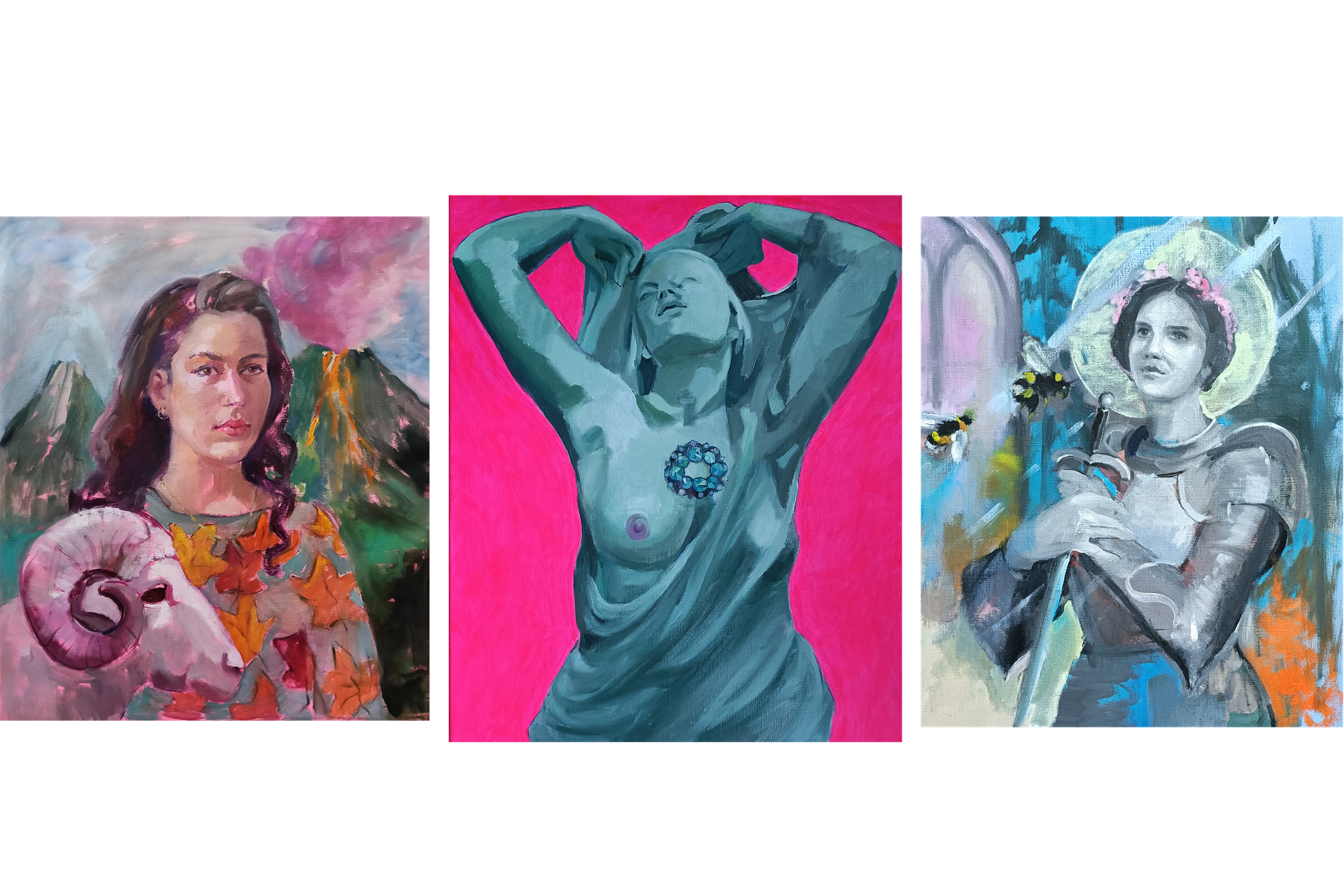
The work closest to her heart is her mythic series, where figures such as Joan of Arc and Athena are reimagined as contemporary visual storytelling. Raised in the Christian tradition, Adams drifted from it before a spiritual deepening in France led her to Jungian depth psychology and its language of symbol and archetype. A teenage love of Greek mythology came back with it.
The female form dominates. “I’m not anti-male,” she says. “It’s working through my own experience of being a woman and the journey of finding the power within. Society definitely minimises women, and I think it’s incumbent on us to find our strength, find our voice. These archetypes help me do that.”
The recognition has followed. In 2024 she showed at Art Capital at the Grand Palais Éphémère and took part in her first museum group show, at the Tokyo Metropolitan Art Museum. In October 2026, three of her mythological paintings, selected by curators, will be shown in an exhibition in Paris.
Soul in France, business in America
Building an art career in France has not been easy. The French art world, she has found, can feel niche and a little closed, and since the pandemic buyers everywhere have grown cautious about what is still treated as a luxury. A lifelong self-employed artist, she responded like an entrepreneur: a web shop, a subscriber list, direct sales and online teaching that keeps her connected to students in New York.
Her collectors are mainly American: fewer than she expected, she says, but very loyal, following her from series to series. Smaller works that ship easily sell best, and still lifes outsell figures because an object leaves room for the buyer’s own associations. As she put it during our conversation: “My soul is in France, but my work life is in the US.”
Moving yourself, not your world
Asked what she would tell other women living between cultures, Adams is candid. “I had this idea that I would take my life in New York and put it in France. I made it in New York, so I can make it in Paris.” She soon caught herself saying, again and again, that something would never happen in the United States.
The shift came when she swapped frustration for curiosity. “I chose to be in France,” she says. “Maybe this new way of doing it is going to be better for me in the long run.” For someone with “that American drive”, patience has had to be cultivated. “I thought I was moving my world, but in fact I’m moving myself and putting myself into a different world.”
Six years on, she owns an apartment in Nice, shares her life with a French partner, and divides her time between Nice and Paris. The girl who once decided she could not paint has found, in a second country and a second language, a fuller version of her own voice.
Liz Adams’s work, classes and mentorships can be found at lizadamsart.com.