
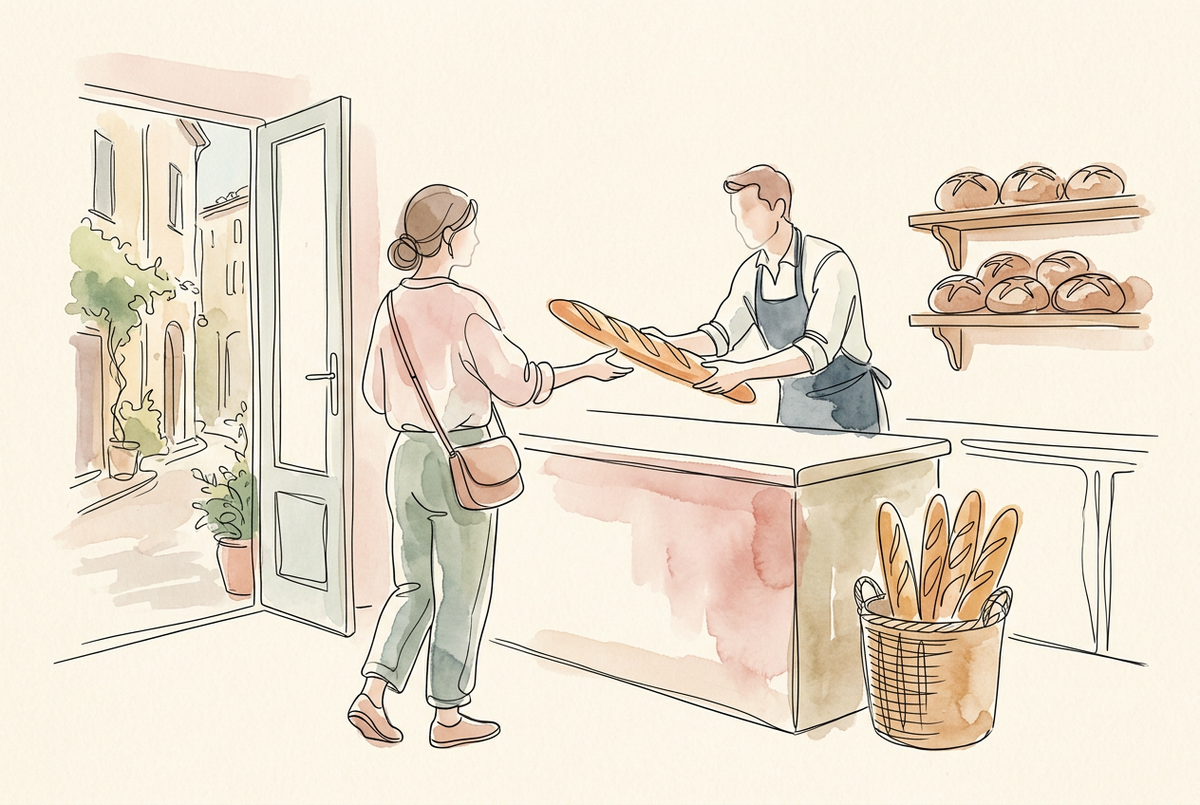
Imagine this.
You've been living in France for a few weeks, maybe a few months. You've been working hard on your French. You rehearse sentences in your head, and maybe even practise in front of the mirror, trying to get your mouth to make those notoriously tricky French sounds. Yes, even that darn French “R”!
And finally, today's the day. You're ready!
You walk into the bakery.
“Bonjour, j'aimerais une baguette, s'il vous plaît.”
You did it! Cocorico! (That's the French rooster crowing in celebration.)
You delivered your sentence without hesitation, wearing your biggest smile and just a hint of that lovely accent of yours.
And then the baker replies: “Of course! Anything else?”
And all your hard work seems to vanish in a second.
Is my accent really that bad? Did she understand anything I said? Am I seriously incapable of ordering a baguette in French?
You leave with your bread, along with a little disappointment.
Now, let's step behind the counter for a moment.
The baker heard your accent, and she was thinking something quite different: “Oh, this person speaks English! Let me make things easier for them. And hey, here's my chance to practise a little!”
She's rather pleased with herself. She's suddenly remembering bits and pieces from her middle school English classes. What a triumph! Apparently, she retained something beyond the legendary “Brian is in the kitchen and Jenny is in the bathroom,” a phrase that practically an entire generation of French schoolchildren grew up with!
As far as she's concerned, everything went beautifully. She was welcoming, she helped someone out, and as a bonus, she got to speak English!
Meanwhile, you're convinced you completely blew it.
Funny, isn't it?
I'm telling you this story because I hear this frustration all the time from the internationals I work with here in Provence.
“Emmanuelle, I don't get it! I prepare what I'm going to say, I make the effort to speak French, and they always answer me in English! Is my French really that bad?”
But what makes me smile even more is that I also know the other side of the story. The French side!
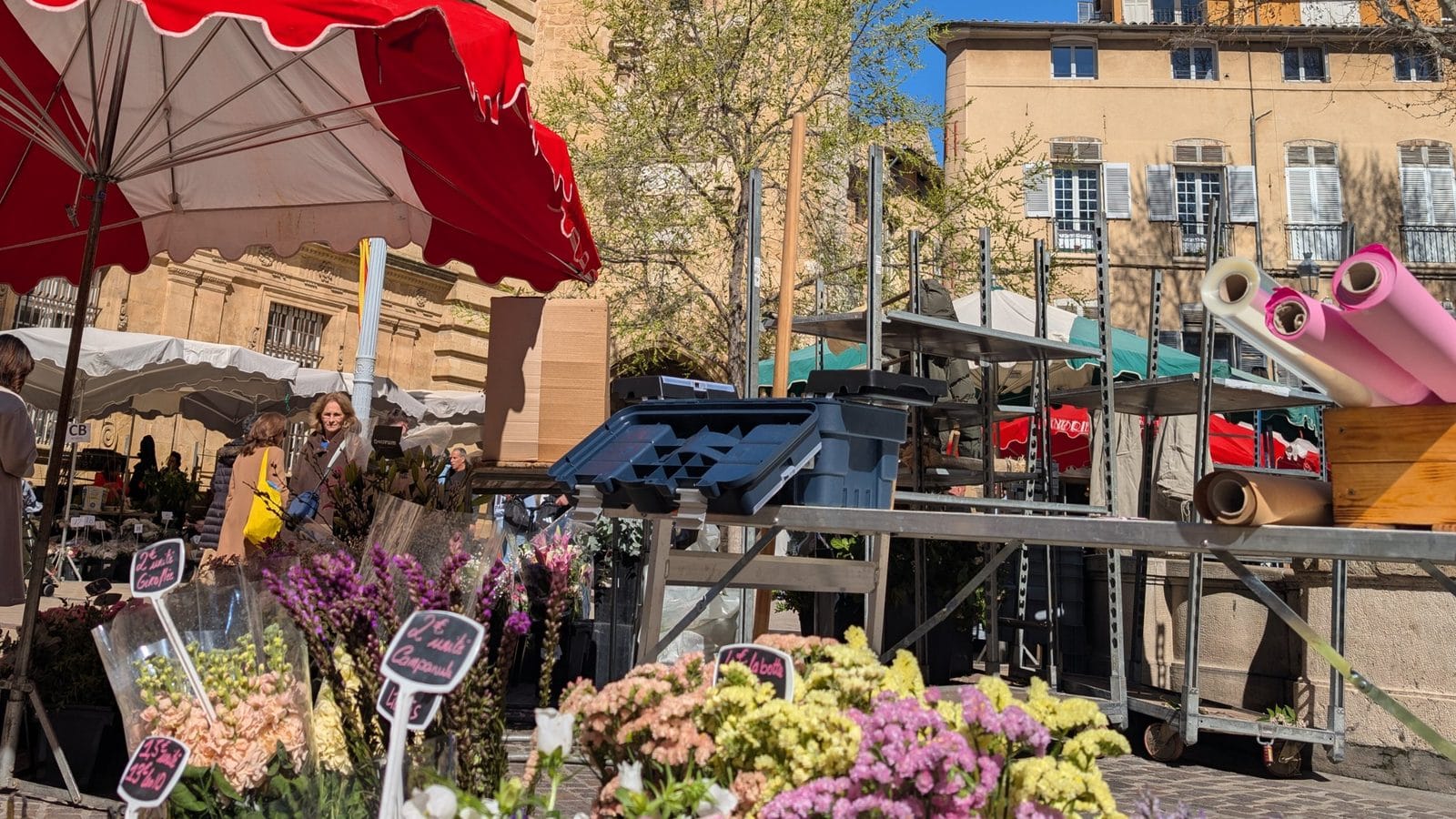
When I take my clients to the local market, vendors sometimes tell me, absolutely delighted: “Oh, they're American? Great! I can practise my English!”
And that's when I jump in: “Oh no, no, no! Today, we're speaking French!”
Sometimes the vendor looks a little disappointed. They were so excited to show off their language skills!
Meanwhile, my client is gathering all their courage to ask for three tomatoes and a piece of cheese in French.
And there I am, in the middle, trying to make sure everyone gets to practise the language they came to speak. It's quite a balancing act!
The thing is, we French have a rather complicated relationship with English. We study it for years in school, but many of us never really feel confident enough to speak it. So when an opportunity comes along, some people are thrilled to show they can manage a few words.
“Wait, wait! I know how to say that in English!”
And I actually find that rather endearing.

I had almost the same experience when I lived in the United States.
In Washington, D.C., all it took was for someone to notice my accent and ask where I was from. “I'm French.” And off we'd go!
“Oh, you're French! Bonjour! Je m'appelle…”
Usually followed by a big smile and the inevitable: “I took French in school, but I've forgotten everything!”
And let's not forget: “Oh, France! Paris! I love Paris!”
Some of them had never even set foot in France, but that certainly didn't dampen their enthusiasm!
Those reactions always made me smile. All I had to do was mention I was French, and suddenly people wanted to speak a language they hadn't used in years.
The vendors at my Provençal market and the Americans I met in Washington had more in common than you'd think!
The difference is that in the U.S., those few words of French never stopped me from continuing the conversation in English. But in France, for someone who's actively trying to learn French, that sudden switch can be really discouraging.
Because it takes courage to speak a language you're still learning. You search for words, you make mistakes, you try again. And sometimes, you just want to buy your baguette without having to switch to English.
So when I explain to the market vendors that my clients are there specifically to practise their French, they usually understand right away and are more than happy to play along.
Of course, sometimes people switch to English simply to save time or because they truly think they're making things easier. But it doesn't necessarily mean your French is bad.
Living abroad taught me something important: we instinctively interpret other people's reactions through our own cultural lens, without always knowing what was actually going through their minds.
It's something I love sharing in my work. Sometimes, understanding the culture can completely change how you experience even the simplest everyday interaction.
So the next time a French person answers you in English after you've delivered your very best French sentence, don't give up.
Just smile and say: “Merci, mais j'aimerais bien continuer en français !”
They might be a little disappointed to put their middle school English back on the shelf… but you might just get yourself a real conversation in French!

Photos in this article courtesy of Emmanuelle Stoessel.